|
|
|
Gem and Stone Information
|
|
|
Turquoise
|
|
Afghanistan Turquoise
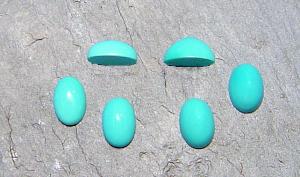
Chinese Turquoise

Howlite

US Faustite Nevada mine

Yellow Turquoise (sometime referred to as Green Turquoise

|
-
Whenever possible, we will list the country or mine of origin of the turquoise we use. Most of our beads are stabilized and will be listed as such. We give as much information as possible about our turquoise as we can in the description of each piece. Turquoise comes in many quality grades and many types.
-
STABILIZED TURQUOISE: About 90% of the Turquoise in the market is stabilized to improve the hardness. Turquoise is a very soft mineral with a MOH's hardness of 4-5. Without being stabilized, the beads would break easily.
Unstabilized turquoise will often change color by absorbing chemicals from soap, perfume, or body oils. Stabilized turquoise may be green (yellow) or blue depending on the color of the original rough.
-
Some turquoise is reconstituted, or ground up
into a powder and then made into what's called "Block Turquoise."
These beads may be misleadingly labeled as "natural turquoise."
-
HOWLITE: There are some websites that have
very low
prices on their "Stabilized Turquoise" beads while those beads are
merely
Howlite beads. Howlite is a mineral that's mined very close to the the
Turquoise mines and often have very similar characteristics as genuine
Turquoise except that Howlite is naturally white. The absence of
copper is what makes the stone white instead of the green or blue of
genuine
Turquoise beads. These Howlite beads are then dyed into turquoise
colors, or others such as red and purple, and sold as substitutes of Turquoise beads. Because of the
abundance of these Howlite stones, the prices of these beads are much
lower
when compared to genuine Turquoise beads.
-
Turquoise beads only come in colors ofgreen, blue, and IA Jewelry Essentialsyellow; and they usually have black, brown or red veinscalled matrix running through the beads. Matrix is not to be considered a flaw, but is highly prized by most 'connoisseurs' of turquoise.
-
"Red Stabilized Turquoise" advertised on some websites is not
real Turquoise.

US varieties
 
Cabachons from the Kingman and Sleeping Beauty Mines above
|
|
|
Pearls
|
|
|
Content
|
|
|
Tagua Nut
|
|

Tagua Nut slice
|
- Tagua Nuts are palm nuts that are harvested in the rainforests of Colombia and Ecuador.
After harvesting, the nuts are dried in the sun for 4 to 6 months. Some
of the dried nuts are then sliced, drilled and polished by tumbling in
water and then in their own media (grinding dust). Some of the slices
are left their natural ivory color and others are permanently dyed.
- The Tagua Nut is also sometimes referred to as "Vegetable Ivory"
due to the fact that it is almost indistinguishable from real ivory. These nuts have been used as an ivory substitute for over 140
years (and appeared as buttons on military uniforms during WWI!) An "Eco-Friendly"
product, the Tagua Nut is a renewable and sustainable product, and
helps support the employment of nearly 35,000 people in the rainforests.
- The pendants we use are dyed with an Analine dye (a
dye used on wood/cellulose produts). The dye is water resistant and maintains its vibrant
color, even when in contact with human skin and perspiration, but since it is a plant product similar in its makeup to wood, there are limitations.
When worn in the water, the Tagua Nut will absorb water and expand slightly in size. It will return to its original shape once fully dry. Constant wear in water, especially chlorine water, may affect the color and durability of
the Tagua Nut slice.
- Tagua Nut slices will benefit from a light polishing with Pledge or
other fine wood care products. Spray a little Pledge onto a soft cloth
and polish the slice with the sprayed cloth. Be sure to polish the
entire pendant; front, back and sides. This should not change the
appearance of the material but will add a light waterproof coating. You
can re-apply the pledge when needed.
- Please note that no two slices are exactly the same
and imperfections do occur.
|
|
|
Other
|
|
|
|

Copyright (c) 2009-2010 WaddoupsWonders. All rights reserved.
info@waddoupswonders.com
|